
Neuromorphic IP Estate · Patents + License · Worldwide Exclusive
A foundational position in the future of computing
The complete Knowm intellectual property estate. Worldwide. Exclusive. All fields of use. The entire stack, atoms to architectures. We are soliciting options for what happens to it next.
Straight answerWhy this is open
Why this is open
I'm Alex Nugent. I invented a lot of what is described on this page, and I run the company that holds it. The next move here is significant and sustained capital raise and organization building. Problem is, those are not the sorts of problems I want to be solving.
So we are soliciting options. The structure is open. An outright acquisition is one version, and depending on who shows up I would consider staying on to consult. A cooperative that holds the estate and grants its participants access is a genuinely interesting idea. So is a consortium, a licensing entity, a joint venture, a spin-out with the right partners, or something nobody has proposed yet.
We don't discuss who we are talking to. We have a number and a short list of things that matter to us. How we get there is negotiable, and creativity is not discouraged. If you have a structure in mind, bring it.
It's the substrate
For more than two decades, one inventor and one company built the patent foundation for the computing paradigm the industry is now racing to catch.
A new physics of compute — where the memory is the processor, where learning happens in the device itself, where intelligence is a material property rather than a software layer. Memristors that do not behave like anything Intel, Micron, or Samsung ship today. Architectures that collapse the von Neumann bottleneck into a single addressable fabric. Learning rules that run in-situ, at the synapse. A photonics interface in the same material stack. LIDAR compression. Autonomous-vehicle perception. The entire ladder, from the chalcogenide thin film up to the cortical algorithm.
What the estate contains
- The full US patent portfolio — seven distinct technology families.
- The exclusive worldwide license, from Boise State, to the M-SDC memristor family — tungsten, chromium, tin, and carbon-doped devices, the back-end-of-line CMOS integration process, and the optically-activated switch, photodiode, and transistor IP that share the same material stack.
Seven families. Two decades. One thesis.
The portfolio is organized into seven technology families, filed continuously from 2002 to 2025. Each was built ahead of the industry trend now racing to meet it.
- Physical neural networks (2002 priority). The earliest claims to learning hardware built from variable-resistance nanoscale connections — the conceptual ancestor of every memristor-based AI chip in development today. Foundational prior art cited throughout the modern neuromorphic literature.
- AHaH (Anti-Hebbian / Hebbian) computing. A complete learning framework implemented in hardware — the broadest currently-enforceable claim set covering on-chip learning in memristive synapses. Runs to 2034.
- Thermodynamic computing and Thermodynamic-RAM (kT-RAM). The kT-bit, the thermodynamic processor, and the full stack from memristor synapse to neural core. The same computing paradigm now being pitched by multiple well-funded startups — patented by Knowm a decade before any of them existed. Runs to 2035.
- Memristor device physics. Apparatus claims covering metastable switching, multi-state synaptic behavior, and the device-circuit interfaces that make adaptive learning work in hardware.
- Hierarchical temporal memory. Cortex-inspired sequence learning in hardware — router-based hierarchies and memristive implementations of HTM concepts.
- LIDAR and autonomous-vehicle perception. AHaH-based point-cloud compression and feature extraction. Directly relevant to every autonomous-vehicle and sensor company with a perception roadmap.
- Unit crossbar topologies (2021 priority). A revolutionary forward-looking architecture filing that, if prosecuted to grant, extends portfolio coverage toward 2041. Will be detailed and demonstrated on this blog.
Across all seven families: no litigation history, no public licensees, no encumbrances beyond disclosed government use rights from prior SBIR/STTR work. The specific terms of the Boise State M-SDC license are fully disclosed under NDA.
Patented before the category existed
Thermodynamic computing is suddenly an industry category. Multiple well-funded startups have raised on the thesis. Every frontier lab has a slide on it. The foundational thinking traces back to the DARPA Physical Intelligence program of the early 2010s — the period when Knowm filed these patents.
- US 8,909,580 — Methods and systems for thermodynamic evolution. Adaptive elements that reconfigure themselves under noise and feedback, dissipating free energy to settle into useful structure.
- US 8,983,886 — Self-evolvable logic fabric. A circuit fabric that grows its own logic pathways. Hardware cores self-organize a flow network from sensor input to a desired output, forming and reinforcing links under a growth rule — and self-repair when damaged.
- US 8,990,136 — Methods and systems for fractal flow fabric. A substrate of nodes joined by flow-stabilized links that grow procedures and solve problems automatically — the self-organizing flow principle, scaled fractally.
- US 9,099,179 — Thermodynamic bit formed of two memristors. The kT-bit. Two memristors in series that return true or false with a probability set by their internal state, steered by positive feedback during a forward-bias read. The atomic unit of thermodynamic computation.
- US 9,152,917 — Framework for the evolution of electronic neural assemblies toward directed goals. A compact architecture for autonomous agents built from four modules — sensors, motors, a reward I/O system, and a cortex. The cortex learns to predict its sensory and motor world, then evolves to predict reward, dominated by the acquisition of free energy.
- US 9,679,241 — Thermodynamic RAM for neuromorphic computing (AHaH). kT-RAM. AHaH nodes whose synapses interact through a common “dendritic” summing electrode, each input individually driven as a memory cell and read in parallel.
- US 10,311,357 — Thermodynamic-RAM technology stack. The full kT-RAM stack — memristor, Knowm synapse, AHaH node, kT-RAM and its instruction set, sparse-spike encoding, emulator, and SENSE server. The integrated hardware-and-software framing of thermodynamic computing.
Whoever holds this estate commands the foundational IP for a paradigm the industry is now racing to commercialize.
The fence the industry is walking into
The industry is converging on exactly the territory this portfolio defines.
Every major semiconductor company is now publicly pursuing in-memory compute, analog AI, edge learning, and neuromorphic architectures. Intel's Loihi and Hala Point. IBM's NorthPole. Samsung's HBM-PIM and memristor crossbar work. TSMC's ReRAM compute-in-memory. Qualcomm, Micron, SK Hynix. Mythic. BrainChip. Innatera. Fractile. Lightmatter. Every one of them is walking toward a fence that was already built — claim by claim, between 2002 and 2025 — by Knowm, working a decade ahead of the field.
Better than every memristor on the market
The M-SDC memristor — available via worldwide exclusive license — outperforms every commercially available competing memristor on the metrics that matter:
- ~0.25 V switching voltage. Lower energy than oxide ReRAM, lower than CBRAM, lower than phase-change.
- ~100 Ω to 1 GΩ resistance range. Seven orders of magnitude of analog dynamic range — what neural networks actually need.
- 150 °C continuous operation. 250 °C glass-transition headroom. Automotive grade. Industrial grade.
- Billion-cycle endurance. Orders of magnitude beyond the cycle counts the industry has celebrated as milestones for competing processes.
- Radiation hard. Space grade.
- Unlimited theoretical shelf life, 10+ years demonstrated.
- >99% manufacturing yield. A real production process, not a lab curiosity.
- Independently validated by hundreds of researchers across dozens of countries. A decade of published third-party characterization — the largest body of independent work for any memristor.
- Single-step sputter deposition. Every layer of the device stack deposits in one pass on a standard sputter tool. No photodoping. No thermal anneal. CMOS back-end-of-line compatible.
3D XPoint took Intel and Micron the better part of a decade and billions of dollars to bring to market under the Optane and QuantX brands. This estate offers a device with comparable or superior performance on a fraction of the process complexity — and the full IP to defend it.
Photonics in the same stack
The same material stack that makes the memristor — chalcogenide Ge₂Se₃ with metal doping — also functions as a light-gated transistor and a photodiode.
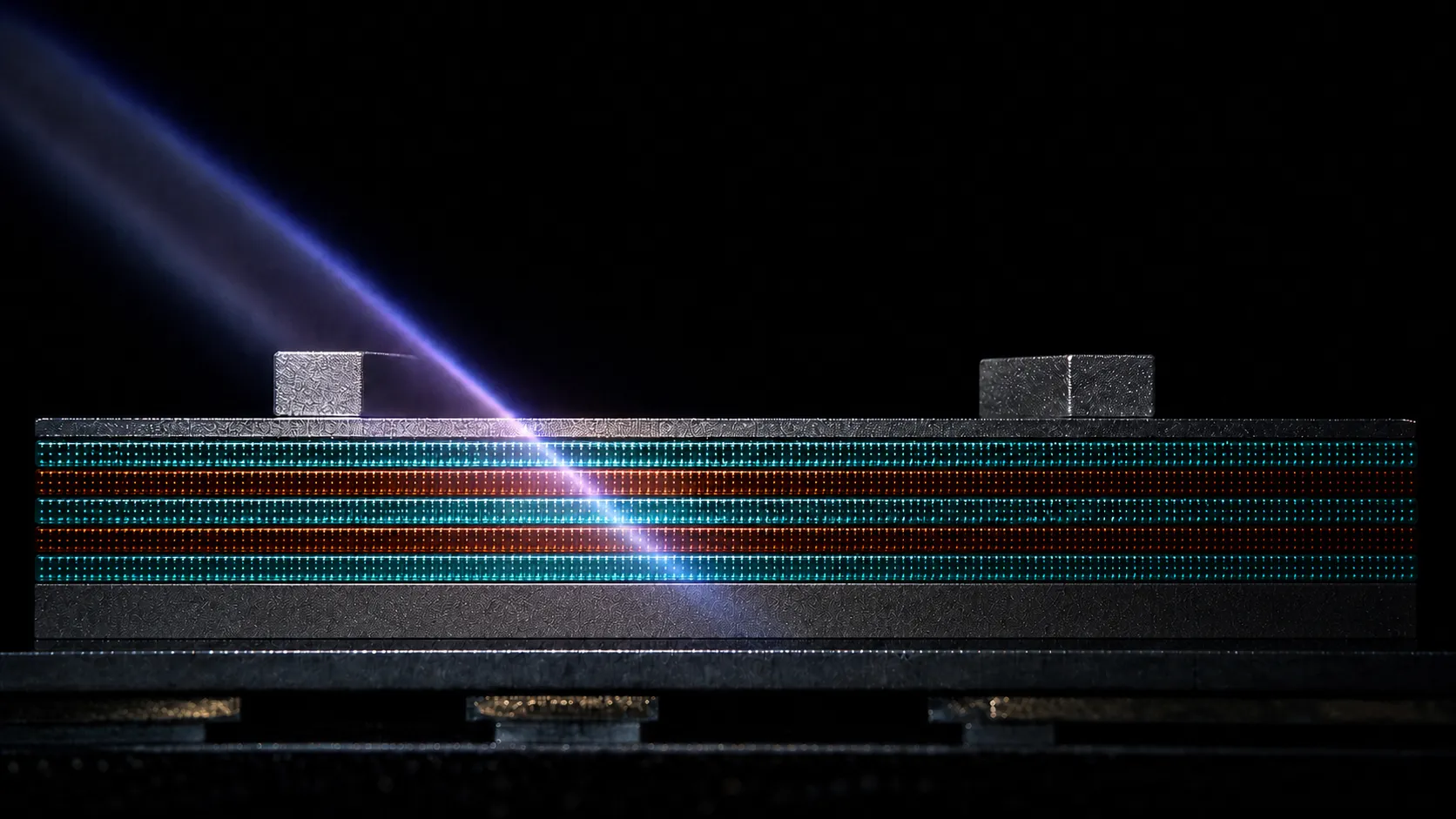
Whoever holds this estate gains the building block of an opto-memristive-electronic neural processor — a chip that computes, learns, and talks to optical I/O in a single integrated stack.
This optionality exists nowhere else. Not at Intel. Not at TSMC. Not at any neuromorphic startup raising on the analog-AI thesis. It sits in this portfolio.
What's in motion
Several families have active continuations that benefit from immediate, well-resourced prosecution. The kT-RAM stack runs to 2034–2035. The 2021 crossbar filing, if prosecuted under the direction of whoever ends up holding it, extends coverage toward 2041. The M-SDC license carries years of remaining exclusivity and a clean royalty structure.
How this works
New blog posts every week or two. The ASSIMILAATE neural lane built in the open, using Knowm memristors, documented as it happens.
Serious interest is handled privately and directly. Qualified parties are kept informed of where things stand. When a stronger position comes in, those already in the conversation are notified and given an opportunity to respond.
Start the conversation
Getting in the conversation is straightforward. Tell us what you have in mind and we will tell you whether it fits. Anything beyond what is published on the Knowm websites requires an NDA.
All information on this page is offered for the purpose of allowing interested parties to self-identify. Patent status, license terms, government use rights, and family details are subject to verification and counsel review under NDA. Nothing on this page constitutes a representation, warranty, or offer of sale; any transaction will be effected solely through definitive written documentation between the parties. Knowm Inc., Santa Fe, New Mexico.