
thermodynamic-computing · generative-models · kt-ram · memristors
CHILL ZEN: Comparator Noise Becomes a Generative Resource for Memristor Neural Lanes
Local learning with comparator-driven sampling, compared with Extropic's Denoising Thermodynamic Model (DTM) on Fashion-MNIST image quality and projected hardware energy.
By Alex Nugent ·
Contents
CHILL ZEN—Comparator-Heated In-memory Lane Learning with Zero-Ended Noise—generates images by sampling a compact symbolic code, repairing it, and decoding it into pixels. Its learned weights are stored as memristor conductances. Adjustable noise in the readout comparator makes sampling stochastic, so the same class label can produce different images. Our new paper presents the architecture, evaluates it on Fashion-MNIST, and compares its image quality and projected energy use with Extropic’s DTM.
The network has two levels. A global code describes the whole image, while residual patch codes add local detail. Separate lane banks sample and repair these codes. Within each bank, a neural lane pools selected pairs of memristor conductances into a score. Sixteen lanes compete to sample each output symbol. The banks learn through local kT-RAM feedback rules.
Extropic’s Denoising Thermodynamic Model (DTM) is a useful reference. It samples images through a chain of Boltzmann-machine denoisers, with repeated Gibbs sampling inside each stage. CHILL ZEN uses a fixed sequence of symbol-sampling and repair steps, with no equilibrium-sampling phase. Fashion-MNIST gives us a small, concrete setting in which to compare the resulting workload, image scores, and projected energy.
CHILL ZEN samples, repairs, and decodes each image#
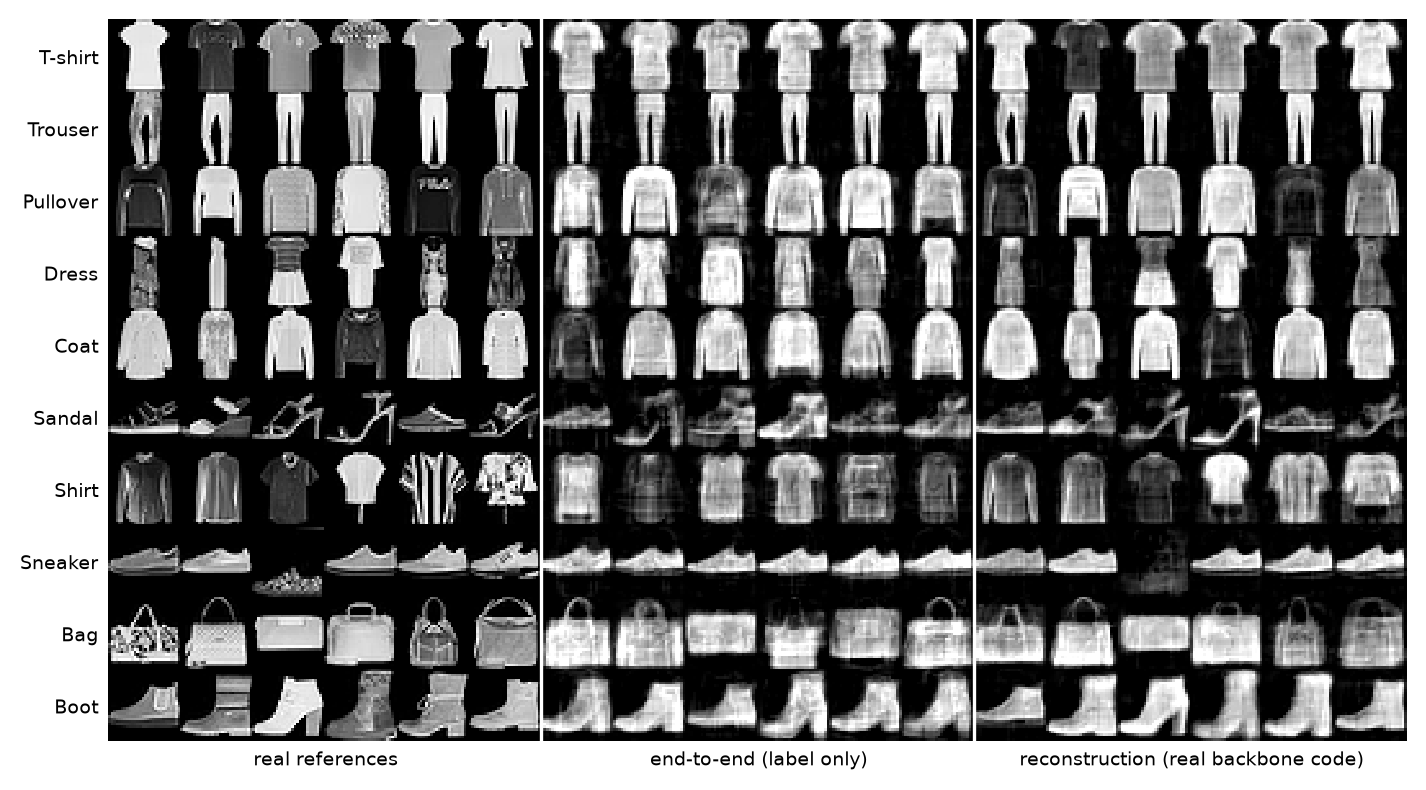
Given a class label, CHILL ZEN samples the 128 global symbols one at a time, each conditioned on the preceding choices. It repairs that code, samples all 98 patch symbols in parallel, and applies one joint repair sweep. A fixed additive decoder turns the resulting 904-bit code into pixels.
That is 131 sampling and repair steps, plus one proposed parallel decode step. Sampling uses 3,616 noisy lane reads; repair and decoding add quieter reads. Additional repair sweeps degrade the reported quality and diversity, so the procedure stops after its prescribed corrections.
All image results come from the neural-core emulator. Bank training uses local instructions without backpropagation; codebook fitting, image decoding, and evaluation run on the host.
The comparator dominates the sampling temperature when many synapses are pooled#
A lane score combines the contributions of many selected synapses. As the pool grows, random fluctuations in individual devices have less effect on the total score. At the chosen read voltage, device noise alone is too weak for useful sampling. The comparator adds adjustable noise and provides 97–99% of the read variance at the grayscale operating point.
The modeled noise budget has three terms:
where is the read voltage and is the comparator’s input-referred RMS noise. At a 10 mV read, the emulator’s device noise is only about 0.02–0.04 in normalized score units. A comparator noise of 2 mV contributes 0.20. Its variance dominates.
The paper’s geometry model makes the changing balance visible:
- Node thermal
- Device flicker
- Comparator: 2 mV RMS
- Comparator: 0.1 mV RMS
Pooling more synapses reduces device noise
Read voltage fixed at 10 mV
Higher read voltage reduces thermal and comparator noise
Pool size fixed at K = 134
Modeled RMS noise at 298 K. The three pools use representative stored magnitudes; connecting lines guide the eye. Comparator curves show alternative settings. The voltage sweep extrapolates the model, not a tested operating range. Here Cnode = (5 + 1.2K) fF; the emulator instead uses a fixed 100 fF.
Larger pools reduce device noise; at fixed read voltage, comparator noise stays unchanged. The balance depends on the comparator setting as well as the pool. With 2 mV comparator noise, even the six-synapse pool is comparator-dominated. With a quiet comparator, the device terms matter much more.
An emulator control supports this interpretation: increasing read voltage fivefold while keeping constant barely changes the image scores, even though thermal noise falls fivefold. Sampling follows the normalized comparator noise.
“Sampling temperature” means read-noise amplitude. Sampling is hot; repair is cold.
CHILL ZEN uses fewer stochastic operations than Extropic’s DTM#
The eight-stage DTM reference uses 250 Gibbs iterations per stage over 4,900 variables: 9.8 million random conditional updates per image. CHILL ZEN uses 3,616 noisy reads, or 10,064 total lane reads including repair and proposed decoding.
These operations have different costs. Extropic estimates about 2 femtojoules for a complete conditional update; our nominal comparator and buffer alone cost 15 femtojoules per lane read. The much smaller workload is what makes the projected saving possible.
CHILL ZEN finishes below DTM
CHILL ZEN finishes in 132 steps
The final four steps use most of CHILL ZEN's energy
The close-up begins after 128 global-symbol sampling steps
Projected energy for one image. The close-up starts at step 128, after all 128 global symbols have been sampled. Steps 129–132 are global repair, patch sampling, joint repair, and decoding. Timing assumes 62.5 ns per complete CHILL ZEN step and 100 ns per DTM half-sweep; it is not measured latency.
The CHILL ZEN curve rises sharply near completion because its last four steps operate whole banks in parallel. Those steps account for about 84% of its modeled energy. A step is a unit of sequence, not a fixed amount of work.
The nominal budget is 2.0 nJ per image for either CHILL ZEN variant, including address delivery, divider reads, readout, and proposed decoding into binary or grayscale pixels. The published DTM figure gives 15.7 nJ for binary output: about 7.9 times as much. Its text’s approximate per-stage estimate gives a smaller ratio of 6.4. Both comparisons exclude programming and external data transfer.
Both CHILL ZEN variants report lower FID than the published eight-stage DTM reference on binarized Fashion-MNIST. FID measures distance between generated and reference image distributions; lower is better.
Binarized Fashion-MNIST
CHILL ZEN reports higher inverse FID than DTM
FID⁻¹ (1/FID) · higher is better
Bars show 1/FID. Original FID values are 24.90 for DTM and 18.09 and 9.69 for CHILL ZEN. DTM is the published result; CHILL ZEN was scored using the released DTM evaluation code. Protocol and reproducibility checks follow.
The binarization threshold moves FID more than the gap between the models. This threshold determines which grayscale pixels become black or white. Holding the scoring code and supplied reference statistics fixed, changing only the threshold from 0.1 to the midpoint, 0.5, moved the same 60,000 real training images’ FID from 0.000039 to 29.75. The real data then scored worse than DTM’s published 24.90—without changing a model or generating a single image.
That makes the threshold’s omission from Extropic’s paper a substantial reproducibility gap. The paper also omits the feature extractor and evaluation sample count, but the threshold check shows just how much one unstated preprocessing choice can dominate the comparison. The released evaluation code specifies 0.1; using the seemingly natural midpoint produces a radically different score against its reference. Meaningful comparisons require that convention to be explicit and consistent.
We evaluated CHILL ZEN using the released DTM scoring pipeline. Extropic’s paper does not document enough evaluation details to establish whether its published FID used that same protocol. We verified the pipeline’s reference statistics with the near-zero self-comparison above and scored 5,120 generated images at the specified 0.1 threshold. DTM’s 24.90 is its published reference value.
CHILL ZEN’s fitting set contains 68,000 images versus DTM’s 60,000, and our noise settings were selected using evaluation scores.
The hardware design still requires comparator, decoder, and crossbar validation#
The most immediate opportunity for hardware builders is a comparator with variable noise control. We invite circuit designers to build and characterize a readout that can reach 2–3 mV RMS input-referred noise for sampling at a 10 mV read, while keeping static offset below about 1 mV. It should also support quieter repair reads. In the emulator, repair at a 50 mV read retained similar aggregate grayscale quality at 100 µV, 300 µV, and 1 mV RMS comparator noise. The 100 µV setting is a modeled floor, not a hard requirement, and these repair tests did not reevaluate FID.
CHILL ZEN already generates grayscale images in the emulator through a fixed additive decoder, whose proposed in-memory implementation is included in our energy budget. That implementation still needs precision and energy validation; using a host decoder would add to the budget. DTM avoids decoding only in the binary benchmark, where its output spins are the pixels. Extropic’s grayscale demonstration uses multiple spins per pixel, and its color demonstration uses a separately trained neural decoder. Those richer outputs are outside the quoted 15.7 nJ binary-image budget. For full-color image generation, the relevant comparison must include the complete generation and decoding costs of both systems.
To address unwanted current paths in the nominal crossbar, the paper proposes an isolated selector-column implementation, estimated at 1.6 nJ per image under the same readout and decoder assumptions.
CHILL ZEN gives us a concrete method to build and test: locally learned scores, comparator-controlled randomness, and a short sampling procedure with a traceable energy budget. The CHILL ZEN repository contains the paper, emulator experiments, and evidence behind the results.