
neuromorphic · companies · taxonomy · funding · ai-hardware
The Chip Companies Trying to Break the von Neumann Bottleneck
Seventy-four companies are trying to break the von Neumann bottleneck with new computing hardware. Here is what they are building and who funds them.
By Tim Molter ·
Contents
In 2015, Knowm started selling memristors. These were self-directed channel devices fabricated at Boise State. We argued that the way past the von Neumann bottleneck was to unite memory and processing in the same physical substrate. Putting the learning in the physics was not the whole argument, but it is critical to methods like ASSIMILAATE.
Back then, “non-von-Neumann computing” was a fringe pitch. In December 2025, a startup with no product raised a $475 million seed round to compute with noisy analog physics. Something changed in those ten years. So I looked for every startup formed to attack the von Neumann bottleneck with unconventional hardware. I wanted to know what each company does, who funds it, and how much money it has raised.
I turned that research into a census. Seventy-four companies made the cut. Each profile covers the founding, the technical approach, and every funding round I could tie to a source. This post summarizes the results, and every dollar figure in it traces to a source URL.
This is the third part of a series. The memristor taxonomy sorted the devices. Beyond von Neumann: Eight Approaches to AI’s Power Problem sorted the paradigms by published results. This post sorts the companies by what the market is doing.
A disclosure, as usual: I work at Knowm, and this census reflects our point of view. I left Knowm out of the charts because we should not score our own company. The paradigms post does score our work on the same axes as everyone else’s.
This census covers companies that claim to use a non-von-Neumann compute substrate. That includes spiking silicon, analog in-memory compute, emerging devices, photons, thermodynamics, living neurons, and event-based sensors.
Digital dataflow accelerators such as Groq, Cerebras, Hailo, and Tenstorrent attack the same memory wall with conventional digital hardware. I excluded them. Two boundary cases, Fractile and MemryX, were close enough to profile. The rest are catalogued for comparison.
I also left out the research chips you might expect to see: TrueNorth, Loihi, NorthPole, Tianjic, BrainScaleS, and SpiNNaker. They are projects from incumbents and universities, not startups. The paradigms post already covers their published results. SpiNNaker’s commercial descendant, SpiNNcloud, renamed Sparxity in October 2026, is included here.
The wave#
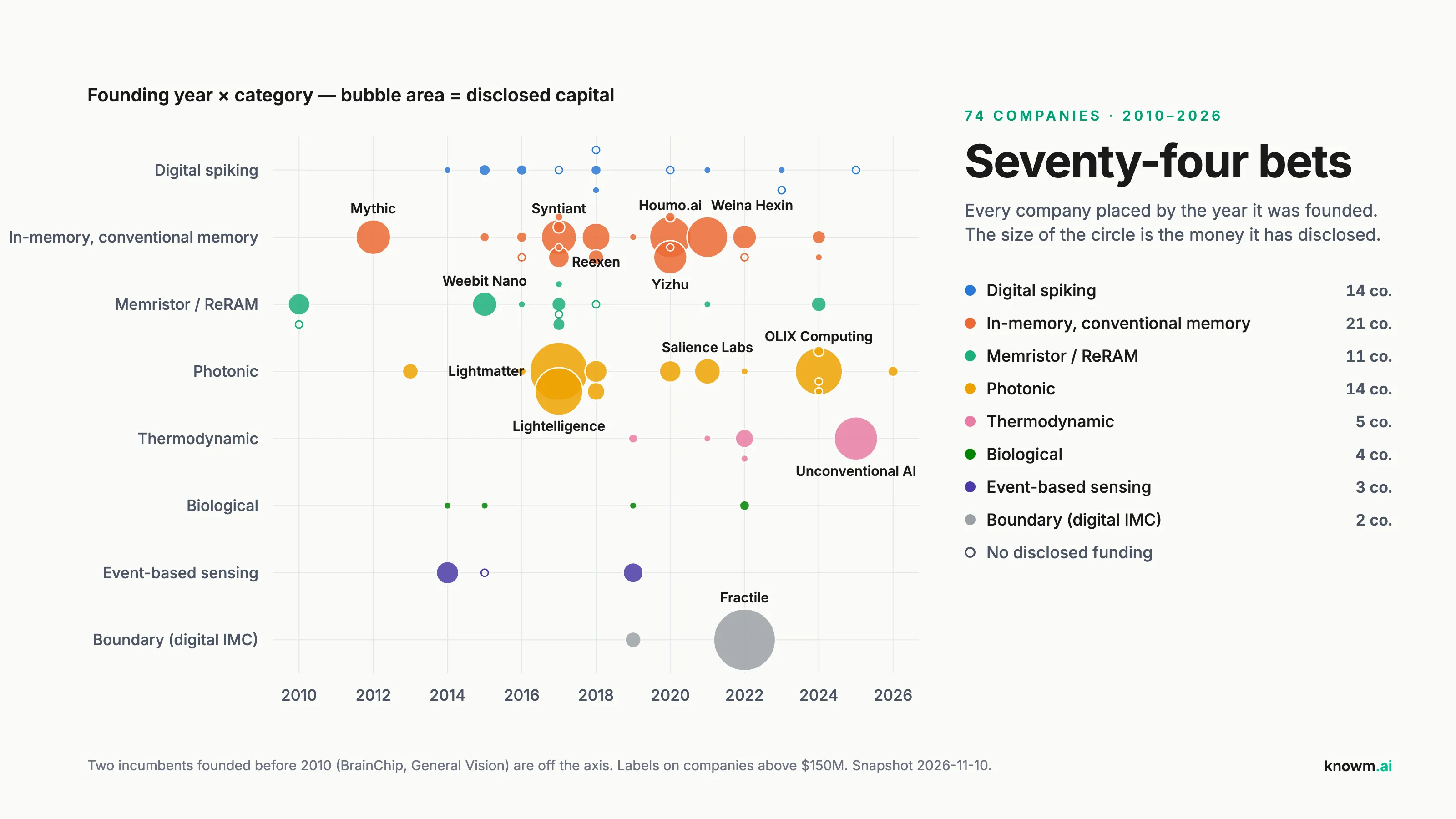
The wave crests in 2017, when twelve companies were founded. They include Syntiant, SynSense, Rain, Witmem, Lightmatter, and Lightelligence. This was three years after IBM’s TrueNorth, which came out of the DARPA SyNAPSE program that Alex helped launch and then advised, and the year Intel announced Loihi, which put “neuromorphic” in the trade press. It was also when the energy cost of deep learning became a mainstream concern.
Foundings per year, colored by technical category. The chart includes 72 of the 74 profiled companies. BrainChip (2004) and General Vision (1999) predate the axis. Founding years come from the company profiles. Snapshot: 2026-11-10.
Most companies in the 2015–2019 group focused on edge computing and sensors. Their products included spiking microcontrollers and analog chips for always-on audio. The 2020–2022 group brought more bets on new devices, including memristor training chips, memcapacitors, and metasurface photonics. The first thermodynamic computing companies also appeared in this period.
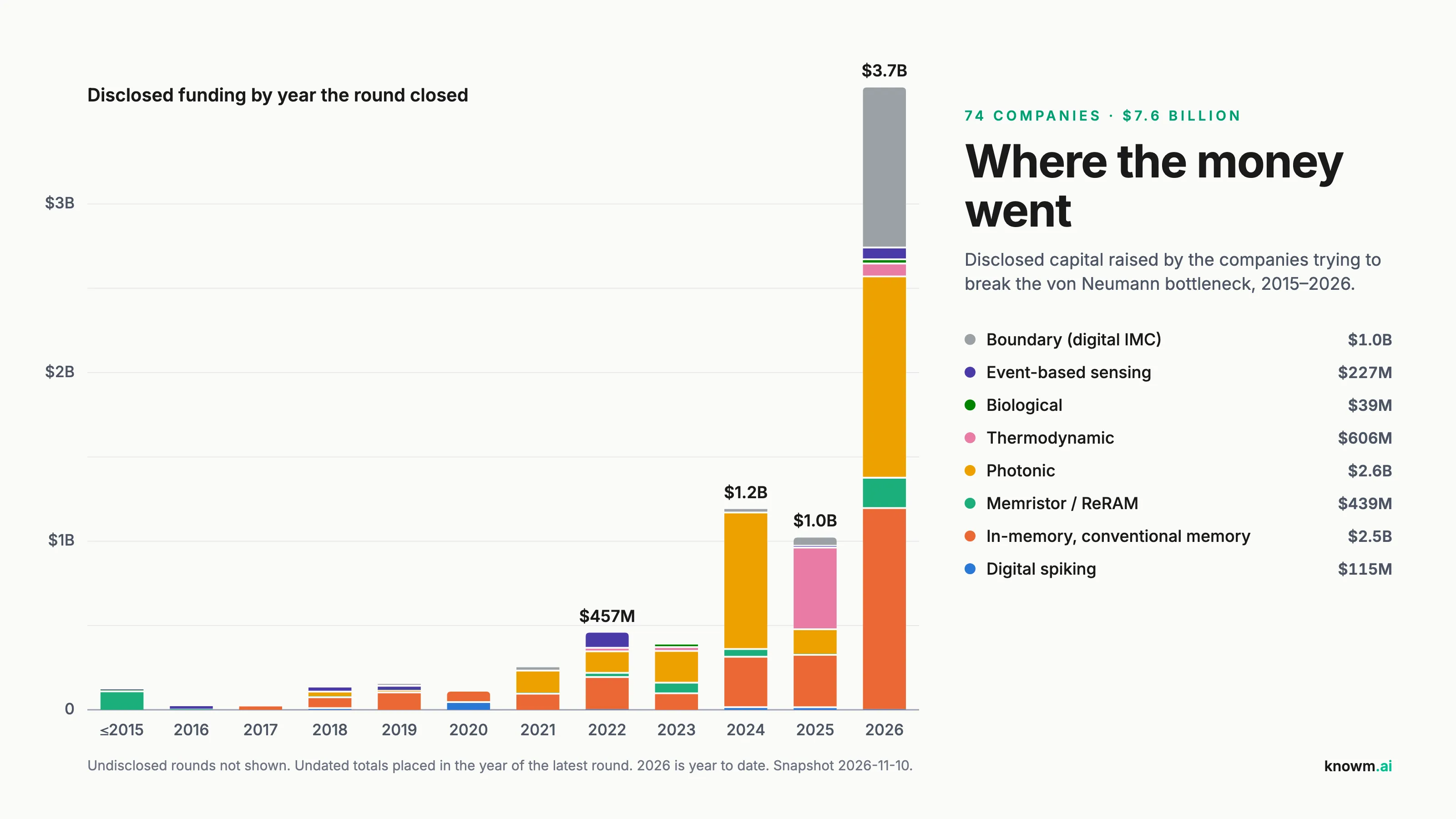
The right edge of the chart is thin, but the companies are not small. OLIX was founded in 2024 and has raised about $560 million, including a $312 million Series B in August 2026 at a $3.3 billion valuation, the largest chip round Europe has seen. Unconventional AI was founded in 2025 with a $475 million seed round. The one 2026 founding, Zhizi Guangyuan, is a Shanghai all-optical computing startup that closed a seed round of several hundred million yuan in November 2026, six months after it was formed. The recent bets are fewer, bigger, and later-stage.
Each bubble is one company, placed by the year it was founded, not the year it raised money, and by category. Bubble area is proportional to disclosed capital to date. Hollow rings are companies with no disclosed funding. Hover for the company, the amount, and the country. Snapshot: 2026-11-10.
My method is unlikely to find a two-person startup founded in 2024 that has not raised money. The chart therefore undercounts the newest companies. I keep a watchlist of about two dozen companies that are still too small or opaque to profile.
Seven ways off the von Neumann road#
Every company in the census names the same enemy: the energy cost of moving data between memory and compute. The taxonomy groups the companies by the alternative physics they use.
The left chart shows all 74 companies by category. The right chart shows about $7.6 billion in disclosed capital by category, including IPO proceeds. Twelve companies add nothing to the right-hand chart: BrainChip funds itself through ASX placements, ten disclose no funding, including SynSense, TetraMem, and Lynxi, and Ceryx Medical’s medical-device capital is left out on purpose. The totals for Chinese companies are incomplete. Every figure comes from a sourced funding table in the corpus.
Photonic companies make up 19% of the census but have received about 35% of the money. The thermodynamic category contains just five companies, or 7% of the census. Yet it has received 8% of the money. Almost all of that came from one seed round in San Diego. The two boundary cases hold about 14%, almost all of it Fractile’s.
- Digital spiking / brain-inspired (14 companies). These chips use sparse, event-driven computation in standard CMOS. They compute only when something changes. This is the most commercially mature category. It includes BrainChip, SynSense, Innatera, Sparxity, and Lynxi. BrainChip has been public since 2015 and is more than twenty years old. The oldest company is General Vision. Its NeuroMem associative-memory chips trace back to IBM’s ZISC neurons of the 1990s. The newest is Neuromorphyx, a 2025 Croatian integrator that builds products on BrainChip’s Akida.
- In-memory compute on conventional memory devices (21). These chips perform multiply-accumulates where the weights sit, so the weights never move. Most do it in analog, through current summing or charge sharing on flash, SRAM, or capacitors. The group includes Syntiant, Mythic, EnCharge, and China’s Witmem. Two Chinese members compute digitally inside the memory instead: Houmo on SRAM and Yizhu on 3D DRAM. Yizhu started as a ReRAM company and moved its production chip to DRAM in 2026, so it now sits here rather than with the memristor companies. A third, Weina Hexin of Hangzhou, stacks SRAM compute-in-memory with near-memory DRAM and has raised more than ¥3 billion since late 2025. It has no English name and no English coverage. I found it in the final sweep before publication, through a Chinese-language search. The category also carries iHW in Korea, Neuronova in Milan, and Ceryx Medical, a UK bioelectronics company whose analog silicon neurons pace hearts rather than run models. I profile Ceryx and keep it out of the money totals.
- Memristor / ReRAM compute (11). Here, the device is the weight. This is our home category. It includes Rain, TetraMem, GEMESYS, and the memory-IP companies Weebit Nano, CrossBar, and Intrinsic. Weebit opened a ReRAM in-memory compute research program in November 2026 and says a product is at least two years out. TetraMem taped out a 12 nm analog in-memory SoC on multi-level ReRAM in October 2026, the first in this group on a FinFET node. The newcomer is CyberSwarm, a Romanian startup that closed a $50 million Series A in May 2026 on a memristor-crossbar pitch with a thin public technical record. MemSilicon, a Beijing ReRAM startup founded in 2024, joins the memory-IP group on the same basis as Weebit: a real memory chip, taped out in October 2026, and a compute-in-memory line with no disclosed silicon. It closed a Series A of more than ¥400 million the same month.
- Photonic (14). These companies perform matrix multiplication with light. They include Lightmatter, Lightelligence, OLIX, Neurophos, and Q.ANT. Great Sky occupies the cryogenic frontier. This 2024 NIST spinout uses superconducting optoelectronic networks to connect single-photon optics with superconducting neurons. Three small entrants hold seed money only: Arago in Paris, Opticore in Fremont, and Zhizi Guangyuan in Shanghai, the only company in the census founded in 2026.
- Thermodynamic / probabilistic / reversible (5). These companies treat noise as a resource instead of an enemy. The group includes Extropic’s sampling hardware, Normal Computing’s thermodynamic ASIC, Vaire’s reversible logic, and Unconventional AI. Thermodynamic RAM was Alex’s 2014 framing of the same idea, and we continue to develop it in the thermodynamic-bit series. These companies arrived at the idea independently a decade later.
- Biological (4). These companies use actual neurons. The group includes Cortical Labs’ CL1, FinalSpark’s organoids, Koniku’s olfactory cells, and the Biological Computing Co.
- Event-based sensing (3). These companies model the retina rather than the brain. They are Prophesee, AlpsenTek, and iniVation.
Follow the money#
It is tempting to say that investors left neuromorphic computing for the LLM memory wall. I do not think that is what happened. The memory wall is the problem these companies were founded to solve.
The chart shows the top 20 companies by disclosed capital in millions of US dollars. The totals include IPO proceeds, and the colors show technical category. A † marks a total on which sources disagree. Both figures appear in the company’s profile. BrainChip cannot be ranked this way because it funds itself through a series of ASX placements. Companies that disclose no funding cannot be ranked either. For example, TetraMem reportedly has a $450 million valuation, but its funding rounds are undisclosed.
Spikes compress bandwidth. In-memory computing keeps weights in place. Neuromorphic companies are also working on the cost of LLMs, and they say so. BrainChip promotes its TENNs models for generative AI. Sparxity and Lynxi sell LLM inference appliances. SEMRON’s memcapacitor roadmap focuses on running LLMs on local devices. I also keep finding practitioners who connect spiking development boards to LLM serving stacks on their own time.
As far as I can tell, the league table sorts companies by how much unfamiliar physics their investors had to accept:
- The top of the table mostly moves data with light or computes digitally inside memory for datacenter LLM inference. It includes Lightmatter, Lightelligence, OLIX, Fractile, whose filings show a Series C of about £540 million closed in October 2026, Weina Hexin, with more than ¥3 billion raised across four rounds in twelve months, and, after a round of more than ¥1 billion the same month, Yizhu on 3D DRAM. Lightmatter has raised $850 million and is now a $4.4 billion interconnect company. Lightelligence completed a Hong Kong IPO in April 2026. These companies sit close to GPUs, fit into existing datacenters, and require no new device physics.
- The middle tier performs analog computing on proven memory devices. Syntiant uses flash, has shipped more than 20 million chips, and filed its S-1 in July 2026; as of early November it had amended the filing twice and still not priced. Mythic nearly died in 2022, was recapitalized, and raised another $125 million in December 2025. EnCharge uses Princeton’s switched-capacitor approach. It has shipped since May 2025 and has received $18.6 million from DARPA. Reexen, which computes in SRAM, raised about ¥1 billion from Meituan, Xpeng, and miHoYo in the six months to October 2026, and Houmo closed a Series B of several billion yuan in November.
- Companies working on emerging devices and neuromorphic computing raise about a tenth as much as the top tier. They are solving the same memory problem, but their plans combine device risk, architecture risk, and software risk.
- Naveen Rao’s Unconventional AI breaks this pattern. It raised $475 million from a16z and Lightspeed at a $4.5 billion valuation. Its pitch openly relies on unusual probabilistic physics. This is the first time in this wave that major venture firms treated “non-von-Neumann” as the headline instead of the fine print.
The sources of the money follow the same pattern. Major venture firms focus on the LLM-era entrants. A16z and Lightspeed back Unconventional AI. Founders Fund, Accel, and Pat Gelsinger back Fractile. Gates Frontier backs Neurophos.
Large technology companies anchor the device-focused startups. Samsung backs Normal Computing and Syntiant. SK hynix backs TetraMem, TRUMPF backs Q.ANT, Huawei’s Hubble backs Witmem, and Sony backs GEMESYS and Prophesee.
Public and defense funding supports much of the neuromorphic group. The EU’s EIC is Sparxity’s largest backer, and DARPA funds EnCharge. SBIR contracts keep half of the small American analog companies alive. Public markets are the last route to survival. BrainChip and Weebit are listed on the ASX, LightOn on Euronext, and Lightelligence on the HKEX. Syntiant filed its Nasdaq S-1 in July 2026 and is still waiting to price.
Who holds the patents#
Money is one ledger. Patents are another, and the two do not line up. In November 2026 I ran one Google Patents query per company, as the assignee, and kept only the rows that came back under the company’s own name. I count patents by invention: a patent filed in the United States, Europe, and China counts once, not three times. The counts are floors, bounded by the pages I fetched, and Chinese utility models count as granted. The query log, the filing counts, and representative patents for every company are in the corpus.
The result inverts the league table. The best-funded companies file little. Unconventional AI and Vaire hold no patents, Normal Computing has two pending applications, OLIX has one patent, and EnCharge has one, because its base IP belongs to Princeton. The patent mass sits in China and in the device and memory-IP companies. Lynxi alone holds 635 patents, more than the next four companies combined, and every established Chinese entrant holds between 82 and 146. Weina Hexin, found days before publication, already holds 90. The Western estates that compare are the ReRAM incumbents, led by CrossBar with 172 patents, 151 of its 186 filings granted, and the photonics cohort.
The fifteen companies with the most patents, from a Google Patents assignee sweep on 2026-11-10, colored by technical category. Each bar counts inventions: a patent filed in several countries counts once. Hover for the number of filings and the granted-to-pending split. The September sweep is kept in the corpus for comparison. Most counts moved by a few percent in two months; Houmo’s rose by half.
Chinese state and strategic capital buys filings as well as chips. Yizhu, Witmem, Reexen, Houmo, and Weina Hexin each out-file Mythic and Syntiant combined. The LLM-era money, by contrast, is betting on architecture and speed to market, not on device IP it can defend. The thermodynamic cohort raised about $600 million against 34 patents, 25 of them Extropic’s and all of those still pending. Rain’s 31 patents are the ones OpenAI bought, and Sync Computing’s seven went to Capital One with the team.
Where they are#
The United States leads both measures, with 30 companies and roughly $2.9 billion in capital. It is also home to almost the entire thermodynamic category.
The left chart shows companies by headquarters country. The right chart shows disclosed capital. Both use the same row order. Companies with two headquarters are assigned to their founding country or primary base. The bar for China is too low because CNY funding rounds are often missing from public reports. Two of the largest Chinese companies disclose no funding at all.
China’s eleven companies report about $2.2 billion in funding, and several are already shipping. Witmem’s flash compute-in-memory chip is in mass production, with unit counts in the millions. Houmo ships automotive compute-in-memory silicon, has moved into edge-LLM chips, laptops, and home hubs, and reports more than 150 design wins for its M50. Yizhu, which started on ReRAM, taped out an all-digital 3D-DRAM inference chip for datacenters on a domestic supply chain in 2026 and raised more than ¥1 billion in October. Lynxi’s chips now run the expert layers of a DeepSeek model in a China Mobile Cloud serving system.
Much of the Chinese capital comes from state funds, Huawei, and China Mobile rather than traditional venture firms. Western funding trackers often miss these investments. The clearest case is Weina Hexin, which raised four rounds of ¥100 million to more than ¥1 billion between November 2025 and October 2026 and never appeared in an English headline. It now sits seventh in the league table. I had to find several rounds in the Chinese press.
Korea entered the census in 2024. iHW raised ₩64 billion inside two years of founding, from the Korea Development Bank and a defense consortium, and has not shipped yet.
European funding follows two different models. The UK produces growth-stage unicorns such as Fractile and OLIX. Germany, France, the Netherlands, and Switzerland produce smaller academic spinoffs supported by grants. The EU, for example, is Sparxity’s largest single backer.
The ASX has become an unusual home for patient neuromorphic capital. It has supported BrainChip for more than a decade and Weebit Nano for ten years. Both companies are still pre-profit.
How it’s going#
Most of these companies are still in business. By my count, 61 of the 74 are active, meaning they have a website, a product or a roadmap, and no report of a shutdown, sale, or pivot away from hardware. Only two have closed outright. That sounds like a healthy field, but the word “active” hides a lot, and the chart below sorts the cohort by what each company actually does now.
Outcomes for the 74-company article cohort, updated November 2026. The label “active” is generous. It includes companies that recovered from near-death, such as Mythic and Prophesee. It also includes pre-product unicorns and quiet companies that have announced nothing in a year. The chart classifies companies by what they do now, not by their original pitch.
-
Defunct: Luminous Computing tried to build a photonic AI supercomputer. It folded in 2023 after raising $123 million. Its intellectual property later reached AMD through a spinout.
Rain is also defunct. The Sam Altman-backed startup abandoned its analog memristor design for digital in-memory computing. It then failed to close a $150 million Series B and failed to find a buyer. Rain laid off nearly all its employees in June 2025. OpenAI passed on acquiring the company or hiring its employees, then bought a number of Rain’s patents. Patent records show an assignment from Rain Neuromorphics to OpenAI OpCo effective October 21, 2025. The price and number of patents were not disclosed. The full story was reported by The Information in August 2026.
-
Recovered from near-death: Mythic collapsed in 2022 and was recapitalized. Prophesee entered French judicial recovery in October 2024. It was recapitalized in 2025 under a new CEO.
-
Moved away from the original goal: Eta Compute, LightOn, and AnotherBrain abandoned novel hardware for software, and Applied Brain Research now sells a voice SDK for commodity CPUs ahead of its own chip. Salience Labs moved from photonic computing to optical switching, and in October 2026 Intel and AMD joined a $125 million Series B to fund the switch. Lightmatter is the best-funded company in the seven categories, but it now sells photonic interconnects instead of photonic computing. Analog computing is hard. The cost of analog-to-digital conversion and the strength of CUDA keep pushing companies toward moving data instead of transforming it.
-
Acquired: Snap bought GrAI Matter Labs in 2023. SynSense bought iniVation in 2024. Capital One absorbed Sync Computing’s team in April 2025 for its cloud-cost software, after Sync had already dropped its oscillator Ising hardware. In all three cases, the value came from consumer, sensor, or software technology rather than compute.
On-chip learning is still almost empty, eleven years after we started shipping devices for it. General Vision has quietly sold digital associative-memory neurons that learn on-chip since the ZISC era of the 1990s. BrainChip advertises on-chip incremental learning, implemented digitally. Germany’s GEMESYS raised an €8.6 million pre-seed round and is developing analog on-device training with memristors. CyberSwarm claims in-hardware learning on memristor crossbars, with little public evidence so far. Biological computers learn by their nature. Among the 74 companies, that is nearly the whole list.
The oldest company on that short list is General Vision, founded in 1999 and largely bootstrapped. Its long history, and the lack of later entrants, show how little capital the market has put into on-chip learning. We hope new ideas like ASSIMILAATE will show how native on-chip learning can resolve the remaining challenges in memristor in-memory hardware. First we have to rethink which problems adaptive hardware is built to solve.
The census, A to Z#
Here are all seventy-four companies, grouped as in the charts, plus Knowm, which sits in its home category but stays out of the charts and the totals. Each census company has a full profile in the corpus, including its funding history and sources. The notes identify companies that no longer do what they were founded to do.
Digital spiking / brain-inspired
-
BrainChip
-
General Vision (pre-wave, since 1999)
-
SynSense
-
Innatera
- GrAI Matter Labs (acquired by Snap; site offline)
-
Sparxity (formerly SpiNNcloud) (renamed October 2026)
-
femtoAI (Femtosense)
-
Applied Brain Research
-
Lynxi
-
Eta Compute (now ModelCat) (pivoted)
-
Neurobus
-
Vivum AI
-
Grayscale AI
-
Neuromorphyx (Akida-based integrator, 2025)
In-memory on conventional memory (flash / SRAM / capacitor / DRAM)
-
Syntiant
-
Mythic
-
Houmo.ai
- Weina Hexin (微纳核芯) (Hangzhou; no English site; added November 2026)
-
EnCharge AI
-
Yizhu (digital CIM on 3D DRAM; started on ReRAM)
-
Witmem
-
Reexen
-
Sagence AI
- iHW (Intelligent HW) (Korea; no public site)
-
AIStorm
-
Blumind
-
Aspinity
-
Ambient Scientific
-
POLYN Technology
-
SEMRON
-
ANAFLASH
-
AnotherBrain (pivoted)
-
Aspirare Semi
-
Neuronova
-
Ceryx Medical (cardiac pacing; outside the $ totals)
Memristor / ReRAM compute
-
Knowm (us; SDC memristors and kT-RAM; left out of the charts by design)
-
CyberSwarm
-
Rain AI (defunct; patents acquired by OpenAI)
-
TetraMem
-
Weebit Nano
-
CrossBar
- MemSilicon (铭芯启睿) (Beijing; no public site found; added November 2026)
-
Intrinsic Semiconductor
-
GEMESYS
-
MemComputing
-
Mentium
-
Bio Inspired Technologies (pivoted)
Photonic
-
Lightmatter
-
Lightelligence
-
OLIX Computing
-
Luminous Computing (defunct; stale site)
-
Neurophos
-
Q.ANT
-
Optalysys (pivoted to FHE)
-
Salience Labs
-
LightOn (pivoted)
-
Lumai
-
Arago (added November 2026)
-
Opticore (added November 2026)
- Zhizi Guangyuan (智子光垣) (Shanghai, founded 2026; no public site found)
-
Great Sky (superconducting optoelectronic)
Thermodynamic / probabilistic / reversible
-
Unconventional AI
-
Normal Computing
-
Extropic
-
Vaire Computing
-
Sync Computing (absorbed by Capital One)
Biological
Event-based sensing
Boundary (digital in-memory compute)
Method and caveats#
I built the census from company websites, press releases, and funding coverage. I did not use papers for this part of the project. The paradigms post covers that evidence. Patents enter only through the assignee sweep above, which counts filings and says nothing about their quality.
Each company profile includes its founding story and technical approach. It also records how the company describes the von Neumann problem. Every number in the funding table has a source URL. If I could not source a number, I marked it as undisclosed instead of estimating it. If sources disagree, the profile keeps both figures and the chart marks the company with a †.
I checked the census against Open Neuromorphic’s community hardware directory. Every commercial hardware maker in that directory appears here. The remaining caveats are:
-
Funding totals include disclosed capital only. The figures are approximate US dollars and include IPO proceeds where noted. Valuations are reported, not verified.
-
Sources disagree on about twenty totals. For example, coverage of Syntiant’s S-1 reports $311 million, while one tracker reports $121 million. AlpsenTek’s stated total does not match the sum of its individual rounds. Both figures appear in the relevant profiles.
-
Chinese totals are partial by construction.
-
Syntiant’s IPO status may be stale by the time you read this.
-
The boundary of the census requires judgment. I included Fractile and MemryX even though they use digital hardware because their in-memory designs are close to the other companies here. I catalogued d-Matrix, Axelera, Untether, and roughly twenty others as boundary cases instead, including the memory makers Kepler Computing and TeRAM and the CXL near-memory company XCENA, all of which raised money in 2026. Untether shut down in mid-2025, and its team moved to AMD. Hailo, a conventional edge-NPU company, raised about $340 million and sold to Microchip in September 2026 for what Calcalist called a fraction of it.
-
Five companies entered the census the day before publication, from a final discovery sweep that used Chinese-language queries: Weina Hexin, MemSilicon, Arago, Opticore, and Zhizi Guangyuan. Their profiles are thinner than the rest and their totals are floors. The patent sweep was re-run the same day so that it covers them.
If I missed a company, tell me and I will add it. If you work for one of these companies and I got a number wrong, tell me and I will fix it.
Further resources#
- A Taxonomy of Memristor Technologies — the devices
- Beyond von Neumann: Eight Approaches to AI’s Power Problem — the paradigms, from 1,327 papers
- The thermodynamic-bit series — our own bet, up close
- The AHaH computing paper: Nugent & Molter, PLoS ONE 2014
- The corpus behind this post: all 74 profiles with every funding round, its source URL, dated news lines, and the patent sweep